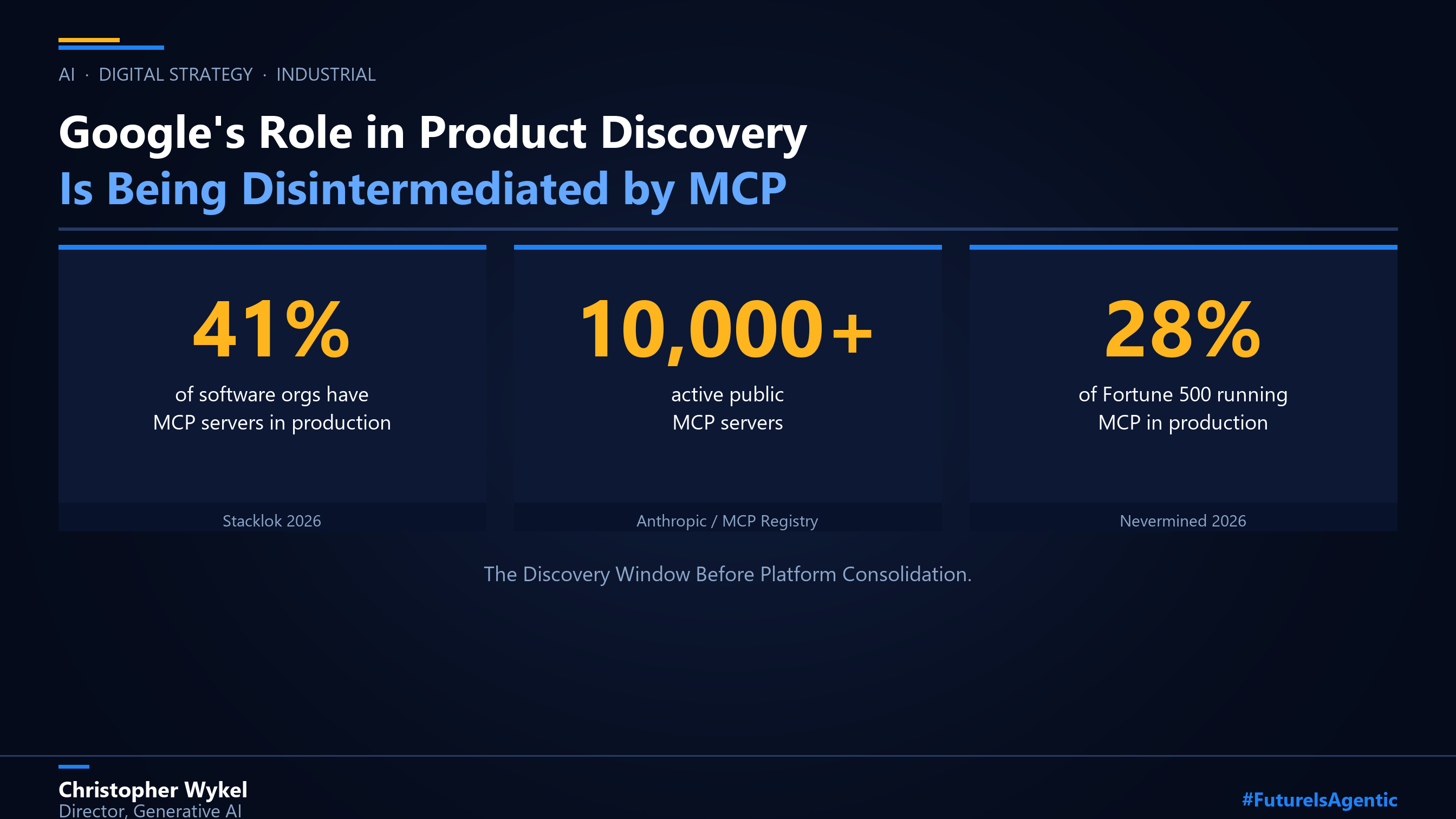
Google built a trillion-dollar business by controlling what you find when you search. SEO was the game you played to win a place in those results. GEO -- Generative Engine Optimization -- is the game you play to appear inside AI-generated answers. AEO -- Agentic Engine Optimization -- is the next layer: whether AI agents can reach your business directly, without crawling and guessing. Google owned the index that made search work. A new index is forming for AI-driven discovery -- and right now, no one owns it. That window will not stay open.
What MCP Actually Is
The Model Context Protocol standardizes how AI applications connect to external tools and data sources. Before MCP, every AI application needed custom connectors for every data source -- an N-times-M integration problem that became a bottleneck as deployments scaled. MCP collapses that to N-plus-M: build one server per resource, and any MCP-compliant client can use it. Anthropic introduced it in November 2024, donated it to the Linux Foundation's Agentic AI Foundation on December 9, 2025, and by mid-2026 every major platform supports it. Think of it as a USB-C port for AI.
The Adoption Numbers Are Clear
The adoption data tells a straightforward story. As of mid-2026, 41 percent of surveyed software organizations have MCP servers in limited or broad production, according to Stacklok's 2026 Software Report. Twenty-eight percent of Fortune 500 companies now run MCP servers in production. The official MCP registry lists more than 9,600 active server records, and Anthropic separately cites more than 10,000 active public MCP servers. GitHub shows nearly 16,000 repositories with the mcp-server topic. Monthly SDK downloads sit at approximately 97 million. Gartner forecasts that 75 percent of API gateway vendors will add MCP capabilities by the end of 2026, and that 40 percent of enterprise applications will include task-specific AI agents by the same date.
How the Gatekeeper Is Changing
To understand what is being disintermediated, it helps to understand what Google actually controlled. Google owned the index. If you wanted search users to find your business, you earned placement in their ranking system or you paid for it -- their criteria, their auction, their terms of service. The entire SEO industry exists because one company controlled which businesses get seen and which do not. That is the model MCP is disrupting.
MCP inverts the discovery relationship. Instead of earning a place in a central index, your business publishes a server that AI agents can query directly, returning structured, authoritative, up-to-date information on your terms. And critically: the current AI discovery landscape is fragmented across competing platforms. Anthropic, OpenAI, Microsoft, Google, and others each maintain their own mechanisms for how agents within their ecosystems find and call MCP tools. No single standard governs how tools are listed, ranked, or surfaced. That fragmentation is, right now, an advantage. The barrier to being discovered by AI agents is lower than it has ever been -- lower than SEO ever was -- precisely because no dominant gatekeeper has yet emerged to control the process. Channel 2 legibility gets you cited. Channel 3 infrastructure gets you queried. Both are accessible today at a cost that will look extraordinarily low in three years.
The Companies Already There
In the eighteen months since Anthropic introduced MCP, every major AI platform has adopted it natively -- including OpenAI, Google, and Microsoft -- a convergence that would not have happened if this were a single-vendor standard. GitHub, Salesforce, and Snowflake all document first-party MCP support. Cursor and VS Code integrate MCP at the IDE level. Cloudflare allows MCP servers to be deployed on its edge network. The infrastructure is in place, the protocol has cross-vendor consensus, and the enterprise deployment patterns are documented and repeatable.
The production use cases now span HR onboarding automation, financial compliance monitoring, marketing intelligence across CRM and analytics platforms, IT incident response, conversational CRM analytics, and internal knowledge search across enterprise systems. Every one of these patterns creates a discovery funnel that businesses can either be inside or outside of.
The Window Before Consolidation
AI platform vendors follow the same economic logic Google did. Control of the discovery layer is valuable. The vendors that consolidate it -- establishing the standards for how MCP tools are listed, ranked, and surfaced -- will have the same structural leverage over your product visibility that Google had over your website traffic. That consolidation will happen. The question is whether your business is established before it does or negotiating for placement after.
The businesses building MCP servers today are not just gaining early access. They are establishing the citation signals, the discovery presence, and the integration patterns that will carry weight when those standards coalesce. The reach available to a well-built MCP server now -- before platform controls tighten -- is larger relative to the effort than anything the same business will achieve once a dominant gatekeeper controls the discovery layer. This is the same window that existed for web presence in 1996 and for search optimization in 2004. In both cases, the businesses that moved early did not just get early access. They got the standard.
The Strategy Behind the Infrastructure
MCP is infrastructure. It answers how, not what. The Channel 2 legibility work and the Channel 3 MCP build are not a sequence -- they are parallel tracks, and the businesses moving fastest are running both at once. Structured content, authoritative citations, and consistent entity presence make your MCP server worth calling. Your MCP server makes the information your Channel 2 work established available in a richer, more direct form. MCP without legibility is a server no agent will find to call. Legibility without MCP means you are findable but shallow. Built together, they constitute a structural competitive advantage that compounds with every quarter you hold it.
Where to Start
The implementation curve is shorter than most executives expect. Anthropic's official documentation at modelcontextprotocol.io/docs/develop/build-server walks through the server build step by step. For an organization with a developer available, a working MCP server is achievable in less than a day. Within a few days of iteration, that server can be returning structured product information directly into the AI tools your customers are already using. For teams that have already prioritized AI infrastructure, the timeline is shorter still.
Set up your MCP server now, while the window of control is wide open. Maximize your discoverability. Take the lead over your competitors before the standards become the barriers to your market reach.
Sources
- Anthropic, November 2024. Model Context Protocol introduced. anthropic.com
- Linux Foundation / Agentic AI Foundation, December 9, 2025. MCP donated. blog.modelcontextprotocol.io
- Stacklok 2026 Software Report. 41% of software orgs have MCP servers in production.
- Nevermined / DigitalApplied. MCP adoption statistics: 28% Fortune 500, 10,000+ servers, 97M monthly downloads. nevermined.ai
- Gartner, 2026. 75% of API gateway vendors to add MCP capabilities; 40% of enterprise apps to include task-specific agents by end 2026.
- MCP official docs (embed as hyperlink in article): modelcontextprotocol.io