The Rules of Discovery Just Changed. Here Is the New AI Driven Landscape.
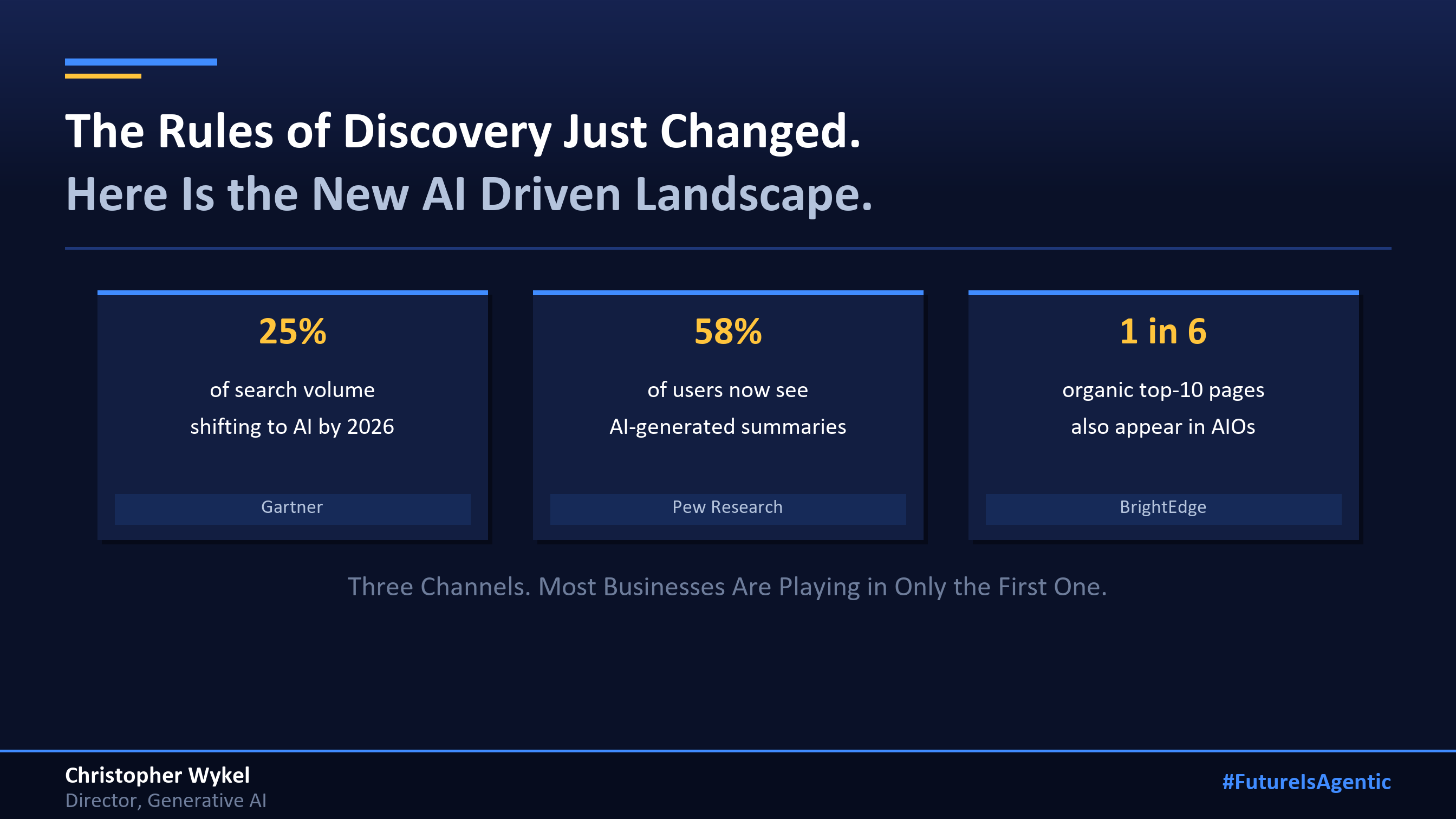
In February 2024, Gartner published a prediction that worked its way into nearly every AI strategy deck that year: by 2026, search engine volume would decline 25%, displaced by AI chatbots and virtual agents.
That deadline is now. We are in 2026.
The question is not whether the shift is happening. It is where that traffic went, and what it means for how your business gets found.
What I am watching across businesses in every sector is a discovery layer that has fractured into three parallel channels. Most companies are investing heavily in one, starting to pay attention to a second, and largely unaware the third exists. That gap is where competitive advantage is being built right now, by the businesses that recognize it early.
Three Channels. Most Businesses Are Playing in Only the First One.
Channel 1 is traditional search: Google, Bing, and the architecture that has driven digital discovery for three decades. Billions of queries per day, a trillion-dollar industry built around ranking for them, and the foundation of most digital marketing investments. Channel 1 is not going away. But the results pages look different than they did three years ago, the click behavior has changed, and the share of queries that complete in Channel 1 without ever producing a referral visit to your site is rising.
Channel 2 is AI-generated answers. When someone types a question into Google and sees a generated summary above the organic links, or researches a topic through Perplexity, or uses ChatGPT Search to get a briefing before a purchase decision, they are in Channel 2. This is the channel most digital leaders are actively arguing about right now. By early 2026, AI Overviews were appearing in roughly 48% of tracked search queries, according to BrightEdge research. Pew Research found that 58% of users conducted at least one Google search in March 2025 that produced an AI-generated summary. The summary is the answer. The link click action, which is Channel 1, is decreasing.
Channel 3 is agentic discovery, and it is the one most business leaders have not built a strategy for. When an AI agent, acting on behalf of a user, researches vendors, compares options, drafts a shortlist, or pre-filters choices before a human ever gets involved, no search query is visible to you. There is no click in your analytics. There is no session. There is no referral source to attribute. The agent decided whether you were worth considering before the customer even sees the options.
McKinsey's October 2025 analysis of AI-driven commerce described the shift directly: the locus of consumer decision-making is moving from a human-mediated search-and-compare model toward a machine-mediated process in which agents increasingly narrow the field before the customer sees it. The customer still decides. But agents increasingly determine who the customer is choosing between.
Where Most Businesses Actually Stand
Most businesses have invested deeply in Channel 1. They have built structured sites, hired SEO teams, run link campaigns, and tracked keyword rankings. That investment is not wasted. Channel 1 still drives real traffic. But it is increasingly insufficient as a sole strategy.
Channel 2 is where forward-thinking digital marketing budgets are now being redirected, and for good reasons. When AI-generated overviews appear in Google results, research from Seer Interactive found a 61% decline in click-through rates on organic links below them. And BrightEdge research found that only one in six sources cited in AI Overviews also ranks in the organic top ten, meaning strong Channel 1 performance does not automatically translate to Channel 2 visibility. If your content is not being cited inside the overview, you are losing share of voice on a channel that operates on entirely different criteria than the one you have been optimizing for.
Channel 3 is where virtually no business has a deliberate strategy, largely because the infrastructure is still new and the measurement problem is genuinely difficult. But the behavior is already occurring at scale. When an AI agent researches on your behalf, it might process several hundred pages in seconds, discard the vast majority, and surface a small set as candidates for you to evaluate. The criteria for what survives that filtering are different from traditional search ranking. The agent is not looking for keywords or backlink authority. It is looking for structured, authoritative, agent-readable content it can actually act on.
What gets filtered out is content built exclusively for the Channel 1 paradigm: content that ranks but does not inform, content that signals relevance to an algorithm without delivering the clean, structured information an agent needs to take action.
This Is a Map, Not a Catastrophe
Gartner predicted a 25% decline in search volume by 2026. Whether that precise number materializes is almost beside the point. The more important structural fact is that the discovery layer has fractured, and the businesses that understand the new geography before their competitors do have a durable advantage.
Maps are useful because they tell you where you are relative to where you want to go. If you are building exclusively for Channel 1 and your customers are increasingly finding answers in Channels 2 and 3, the map tells you exactly what to do: extend your presence.
This does not mean starting over. Channel 1 investment has real value, and some of that infrastructure carries forward into Channels 2 and 3 (structured content and domain authority matter everywhere). It means recognizing that discovery is no longer a single channel, and that a business visible in all three channels has a structural advantage over one visible in only one.
The competitive reality is that most businesses have not acted yet. That window will not stay open indefinitely. The companies building content and interfaces that AI systems want to cite and interact with are accumulating a first-mover advantage that compounds the longer competitors wait. I am watching it happen in industrial and manufacturing sectors where the purchasing cycle is long, the vendor relationships are sticky, and the decision-maker is exactly the kind of person who increasingly asks an AI assistant to do the first round of research before a conversation ever happens.
Knowing the Map Is Not the Same as Knowing Your Position
Three channels exist. The more interesting question is where you stand in each of them.
Channel 1 is the easiest to assess. Search for the business problem your product solves, not your company name. See where you appear, and whether you appear at all.
Channel 2 is harder but still testable. Run the same search in Google and look at whether an AI Overview appears above the organic links. If one does, read it. Is your brand cited, paraphrased, or referenced anywhere inside it? Pew Research found that 58% of users are now regularly encountering AI-generated summaries in their Google searches. If you are not in those summaries, you are losing share of voice on a channel that is growing faster than traditional organic.
Channel 3 is the least visible and the most revealing. Open Claude, ChatGPT, or Perplexity. Ask it the question your best customer would ask before reaching out to a vendor. See who surfaces, how they are described, and whether your company appears at all. Channel 3 produces no analytics footprint: there is no session, no referral, no click to count, which is precisely why most businesses have no idea how they are performing in it. The buyers are there and the volume is growing. The platforms that solve the Channel 3 visibility problem will be the Googles of tomorrow.
The results of that exercise will tell you more about your discoverability than any analytics dashboard currently available to you. Know that the results are sometimes uncomfortable. You may find you are invisible in channels where your competitors are not.
Channel 1 has decades of documented playbooks. If you need to improve your search ranking, the internet has no shortage of guidance. What is less documented is how to improve your standing in Channels 2 and 3.
For Channel 2, three things move the needle: write content that answers specific questions directly (AI systems favor citable answers over keyword density), publish original data or research that gives AI systems something concrete to reference, and structure your content with clear headers and summaries an AI can extract without full context. Princeton researchers studying AI citation patterns found that structured, authoritative content gets cited by AI systems at rates 30 to 40 percent higher than unstructured content.
For Channel 3, the first step is the same one that applies to Channel 2: ensure your product and service information is structured, unambiguous, and consistently presented. Agents parse information to make recommendations, and inconsistent or vague descriptions create gaps that better-prepared competitors fill. Visibility across multiple platforms and sources also matters: the more places an AI agent can find consistent, accurate information about you, the higher the likelihood it surfaces you as a result. And resist the instinct to block AI crawlers from your site. It is a tempting defensive move, but it makes you invisible in the channel that is growing fastest. The deeper infrastructure work for Channel 3 involves building interfaces that AI agents can query directly; that deserves a deeper dive, as it is a bigger subject.
If you run the test and are not sure what to do with what you find, send me a message. Happy to point you in the right direction.
Sources
- Gartner, Feb 2024. Gartner Predicts Search Engine Volume Will Drop 25% by 2026, Due to AI Chatbots and Other Virtual Agents. gartner.com
- BrightEdge, 2026. AI Overviews appearing in ~48% of tracked queries; only 1 in 6 AIO sources also ranks in organic top 10. brightedge.com
- Pew Research Center, Jul 2025. 58% of users conducted at least one Google search in March 2025 that produced an AI-generated summary. pewresearch.org
- Seer Interactive, Sep 2025. AI Overviews drive 61% drop in organic CTR. [Previously cited in Post 2] seerinteractive.com
- McKinsey, Oct 2025. The Agentic Commerce Opportunity: How AI Agents Are Ushering in a New Era for Consumers and Merchants. mckinsey.com
- GEO: Generative Engine Optimization. Princeton / ACM KDD 2024. 30-40% higher citation rates for structured content. [Previously cited in Post 2] arxiv.org